










A wheelchair ramp is one of the most cost-effective ways to restore independence at home and in the community. But ramps come in a wide range of materials, configurations, and weight capacities — and choosing the wrong type can create safety problems or simply not fit your space.
This guide covers the four main ramp categories and how to match each to your specific situation.
Threshold Ramps
Threshold ramps address the most common obstacle in any home: the small lip or step at a doorway, shower, or sliding glass door. Even a 1–2 inch rise can be enough to stop a wheelchair or scooter cold.
Best for: Doorway lips, bathroom transitions, sliding door tracks, van floor-to-driveway transitions
Material: Aluminum (lightweight, no maintenance) or rubber (non-slip, durable, absorbs minor height changes)
Height range covered: ½ inch to 6 inches depending on model
Installation: None — just set in place. Can be moved room to room as needed.
Cost: $30–$200 depending on height and material
If your home has multiple threshold obstacles, buying several rubber or aluminum threshold ramps is usually faster and far less expensive than cutting doorways or installing permanent ramps.
Portable Folding Ramps
Portable folding ramps are the most versatile ramp category. They fold in half (or into a suitcase-style carrying handle) for transport and storage, making them ideal for travel, visiting family, or use at multiple locations.
Best for: Vehicle access, home entry steps (1–3 steps), travel, and temporary use situations
Material: Aluminum with non-slip surface channels
Length available: 2 ft to 10 ft
Weight capacity: 600–800 lbs on quality models (always verify for bariatric chairs)
Weight of ramp itself: 12–30 lbs depending on length — important for caregivers who must carry and deploy it
Choosing the Right Length
The most common mistake when buying a portable ramp is choosing one that’s too short.
A steep ramp angle is unsafe and difficult to navigate — especially for power chair users who may tip backward, and for manual chair users who cannot generate enough force to push up a steep grade.
The general rule is 1 inch of ramp length per 1 inch of rise for powered chairs, and 2 inches of ramp length per 1 inch of rise for manual chairs. So a 12-inch step (1 foot) needs at least a 5-foot ramp for a power chair and a 7-foot ramp for a manual chair used independently.
ADA guidelines recommend a maximum slope of 1:12 (1 inch of rise per 12 inches of length) for accessible ramps.
Modular Ramp Systems
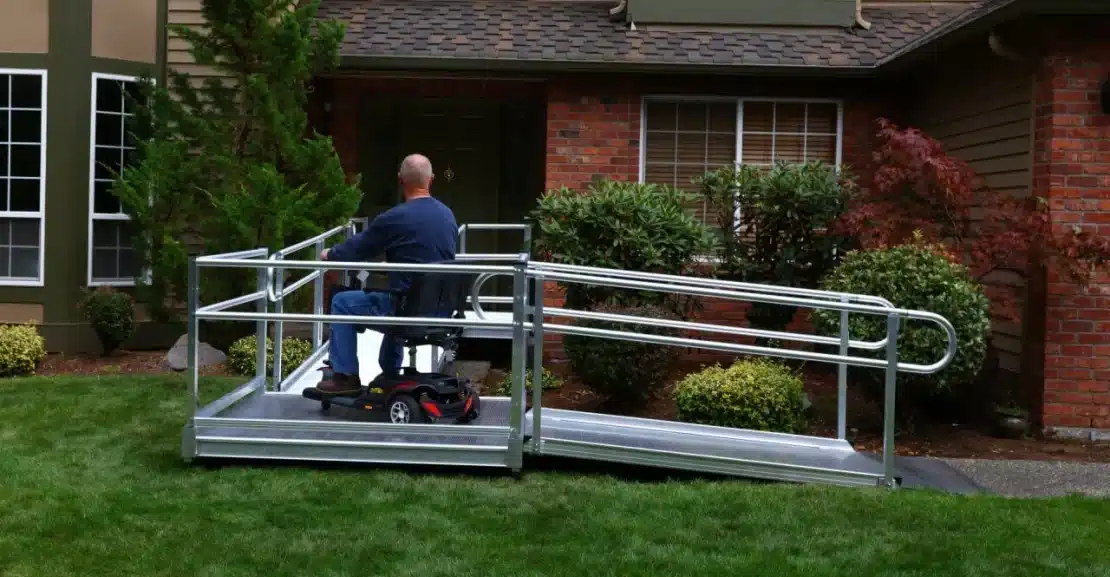
Modular ramps are pre-engineered aluminum panels that bolt together on-site to create a permanent or semi-permanent ramp system. They can be installed in L-shapes, switchbacks, or straight runs and include handrails, platform landings, and non-slip surfaces as standard.
Best for: Home entries with 3+ steps, situations where a permanent solution is needed, rental properties (modular ramps can be disassembled and relocated), and applications where a wooden ramp is impractical due to maintenance or space
Advantages over wood ramps: No painting, no rotting, no warping. Aluminum modular ramps require virtually no maintenance. They also maintain consistent weight ratings year-round regardless of weather.
Lead time: Modular ramps are typically measured, ordered, and installed within 1–2 weeks. Access 2 Mobility handles the full process — measurement, design, delivery, and installation by certified technicians in the Tyler, TX area.
Cost: $1,500–$6,000+ depending on total length, platforms, and configuration
Vehicle Ramps
Vehicle ramps are purpose-built for loading wheelchairs and scooters into vans, SUVs, and trucks. They’re different from portable folding ramps in that they’re typically stored inside or under the vehicle and rated for heavier loads at steeper angles.
Types:
- Fold-out ramps: Stored in the vehicle, fold down manually when needed. Common on cargo vans and some minivans.
- Roll-up ramps: Flexible track-style ramps that roll up for storage. Very compact but require more upper body strength to push a chair up.
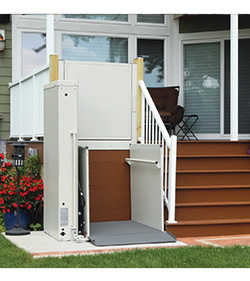
- Vehicle lifts: Platform lifts that raise and lower electrically. Best for heavy power chairs, scooters, or users who cannot self-propel up a ramp at all. Installed at the rear or side of vans, trucks, or SUVs.
Note: Powered in-floor ramps (standard on BraunAbility Chrysler Pacifica conversions) are a separate category built into the vehicle — not an add-on. See our accessible van conversion page for details.
What to Verify Before Buying Any Ramp
- Weight capacity — the ramp must be rated for wheelchair + occupant + chair weight. Don’t cut it close.
- Surface traction — aluminum channel surfaces are good; smooth aluminum is slippery when wet. Ask about surface texture.
- Edge lips — good ramps have raised edges (lips) to prevent wheels from slipping off the side
- Width — the ramp must be wider than your wheelchair’s widest point, including armrests
- Connection points — vehicle ramps should hook or strap to the vehicle to prevent sliding
Ramps In Stock — Tyler, TX
Access 2 Mobility carries a full selection of wheelchair ramps in our Tyler showroom — threshold ramps, portable folding ramps from EZ-Access and Prairie View Industries, and modular ramp systems.
We also measure and install modular ramps at homes across East Texas.
Not sure what you need? Bring your wheelchair or describe your situation and we’ll help you find the right solution. Call (903) 592-6760 or contact us online. Open Monday–Friday, 8:30 AM–5 PM.




